
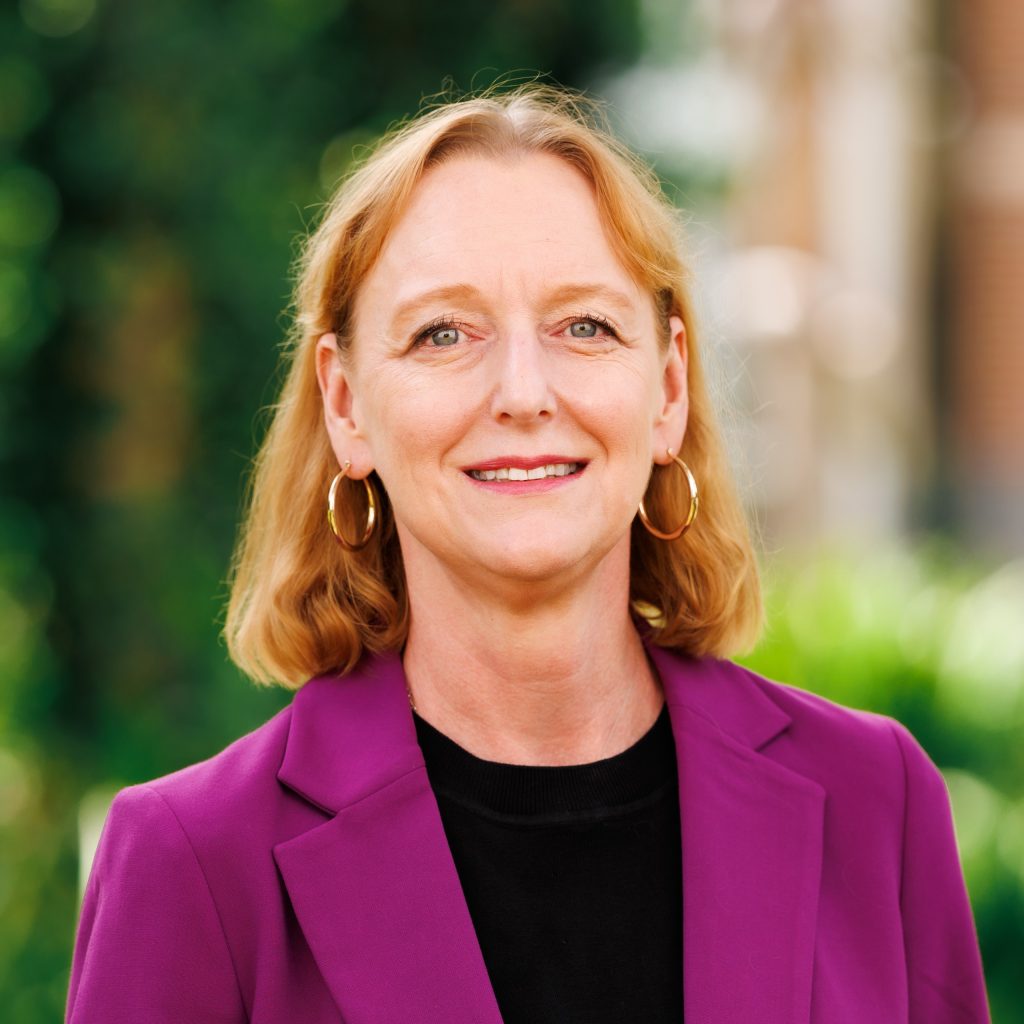
Lyrissa Barnett Lidsky
Raymond & Miriam Ehrlich Eminent Scholar Chair in U.S. Constitutional Law
Distinguished Professor of Law
Lyrissa Lidsky is a Distinguished Professor of Law and the Raymond & Miriam Ehrlich Eminent Scholar Chair in U.S. Constitutional Law at the University of Florida Levin College of Law. Her scholarship and teaching center on the intersection of Tort Law and the First Amendment, with particular focus on defamation, privacy, artificial intelligence liability, and free expression on digital platforms.
Professor Lidsky serves as Co-Reporter for the American Law Institute’s Restatement of the Law Third, Torts: Defamation and Privacy. She is the author of Sack on Defamation: Libel, Slander, and Related Problems, having succeeded the Honorable Robert Sack, and co-author of leading casebooks on First Amendment Law and Mass Media Law, as well as a treatise on press freedom. Her scholarly articles have appeared in premier journals including the Virginia Law Review, California Law Review, and Duke Law Journal, and her work has been cited by numerous state supreme courts, federal appellate courts, and the highest courts of Canada and Hong Kong.
From 2017 to 2022, Lidsky served as Dean of the University of Missouri School of Law, where Missouri Lawyers Media honored her as its 2020 Woman of the Year in recognition of her institutional leadership, scholarship, and student mentorship. Before her deanship, she held the Stephen C. O’Connell Chair in Law at UF Law and served in multiple associate dean roles. Over more than three decades in legal education—including over 25 years at UF—she has earned numerous honors for classroom excellence, including student-selected Teacher of the Year awards, Faculty Graduation Speaker honors, and university faculty committee distinctions.
At the outset of her career, Professor Lidsky clerked for the Honorable Joseph T. Sneed of the U.S. Court of Appeals for the Ninth Circuit. She earned her J.D. with high honors from the University of Texas School of Law, where she was initiated into the Order of the Coif and served as Articles Editor of the Texas Law Review. Prior to law school, she was a Fulbright Scholar at Cambridge University, studying medieval legal history and the development of the Common Law, and graduated summa cum laude in English and Political Science from Texas A&M University.
Education
J.D., University of Texas (with high honors)
B.A., Texas A&M University (summa cum laude)
Expertise
Artificial Intelligence, Constitutional Law, Defamation, First Amendment, Free Expression, Freedom of Information Act, Internet Law, Media Law, Privacy Torts, Professional Responsibility, Social Media, Tort Law
Teaching & Scholarship
Torts, Advanced Torts (specializing in Defamation and Invasion of Privacy), Mass Media Law, Internet Speech, Jurisprudence, First Amendment Law and Social Media, Freedom of Speech, Cyberbullying.
Publications
Books
- Lidsky on Defamation: Libel, Slander and Related Problems (full revision forthcoming PLI 2028) (Volumes I & II) (work in progress).Sack on Defamation: Libel, Slander and Related Problems (PLI 2017) (Volumes I & II) (2025 & 2026 Updates).
Restatement of Torts, Third: Defamation (Tentative Draft of sections 1-14 approved by membership May 2026) (ALI Council Draft August 2025) (preliminary draft 5) (2025); (preliminary draft 4) (2024); (preliminary draft 3) (2023); (preliminary draft 2) (2022); (preliminary draft 1) (2021) (Co-reporter: Robert Post). Tentative Draft of sections 15-20 forthcoming March 2027)
First Amendment Law: Cases and Materials (Aspen) (5th ed. forthcoming fall 2026 with new Teacher’s Manual) (4th ed. 2022 with Ronald Krotoszynski, Jr, Timothy Zick & Caroline Corbin)(3d ed. 2017 with Ronald Krotoszynski, Jr, Christina E. Wells & Caroline Corbin). (1st ed. 2008, 2d ed. 2013, 3d ed. Forthcoming 2021 with Ronald Krotoszynski, Jr, Steven Gey & Christina E. Wells).
Mass Media Law: Cases and Materials (Foundation) (9th ed. 2016 with Marc A. Franklin, David A. Anderson & Amy Gajda) (7th ed. 2005 & 8th ed. 2011 with Marc A. Franklin & David A. Anderson). (New edition forthcoming Fall 2027)
Freedom of the Press, Greenwood Press Series on the Constitution (2004 with R. George Wright).
Torts: The Civil Law of Reparation for Harm Done by Wrongful Act (Matthew Bender) (2009, 2014 with Joseph W. Little & Robert Lande).
Book Chapters
- Unlocking the Black Box of Reputational Harm, in Research Handbook on Defamation Law (editor: David Rolph, University of Sydney) (forthcoming 2027).Defamation Law and the Crumbling Legitimacy of the Fourth Estate, in The Future of Press Freedom: Democracy, Law, and the News in Changing Times (RonNell Andersen Jones and Sonja R. West, eds., 2025), available at https://www.cambridge.org/core/books/future-of-press-freedom/future-of-press-freedom/26906D66B75447701709A78BB2601A7D
- The Gordian Knot of Defamation Reform, in Media and Society after Technological Disruption (Kyle Langvardt and Gus Hurwitz, eds., 2024), available at www.cambridge.org/9781009174428
- Recent Developments in the Law of Social Media, in COMMUNICATIONS LAW IN THE DIGITAL AGE 2014 (PLI November 2014) (with RonNell Andersen Jones).
- Recent Developments in the Law of Social Media, in COMMUNICATIONS LAW IN THE DIGITAL AGE 2013 (PLI November 2013) (with RonNell Andersen Jones).
- Recent Developments in the Law of Social Media, in COMMUNICATIONS LAW IN THE DIGITAL AGE 2012(PLI November 2012)(with Ron Nell Andersen Jones).
- Legal Pitfalls of Social Media Usage, in SOCIAL MEDIA: USAGE & IMPACT (Hana Noor Al-Deen & John Allen Hendricks, eds., 2011) (with Daniel C. Friedel).
Articles
- Presumed Damages Reconsidered (forthcoming 2027) (co-author: Jordan Armga) (accepted for presentation at FIRE conference in March 2027)Editing the First Draft of History: Presidential Leverage, Press Vulnerability, and the Weaponization of Defamation Law (draft available) (submission expected January 2027)
Inevitable Errors: Defamation by Hallucination in AI Reasoning Models, 6 J. Free Sp. Law 477 (2025) (Co-author: Andrew Daves). Selected through a competitive process for presentation at Tubingen Conference for AI and Law, Nov. 5-6, 2025.
Are You the Sum of Your Data? Appropriation of Digital Persona as Appropriation of Likeness, JOTWELL (July 2025) (reviewing Zahra Takhshid’s Data as Likeness, 112 Geo. L.J. 1161 (2024).
Defamation Law and the Crumbling Legitimacy of the Fourth Estate, Knight First Amendment Institute at Columbia University, July 11, 2024, available at Defamation Law and the Crumbling Legitimacy of the Fourth Estate | Knight First Amendment Institute (knightcolumbia.org).
First Amendment Disequilibrium, 110 Va. L. Rev. 1 (2024). Reprinted, First Amendment Law Handbook, 2023-2024 Edition (Rodney Smolla, ed.). Selected as winner of the 2025 Harry W. Stonecipher Award for Distinguished Research on Media Law and Policy, presented by the Law and Policy Division of the Association for Education in Journalism and Mass Communication.
The First Amendment and Professorial Classroom Speech, JOTWELL (Jan. 19, 2024) (reviewing Keith E. Whittington, Professorial Speech, the First Amendment, and Legislative Restrictions on Classroom Discussions, 58 Wake Forest L. Rev. 463 (2023).
Untangling Defamation Law: Guideposts for Reform, 88 Mo. L. Rev. 663 (2023).
- Cheap Speech and the Gordian Knot of Defamation Reform, 3 J. Free Speech L. 79 (2023).
- Aren’t We Special?: Article III’s Institutional Design, JOTWELL (June 27, 2023) (reviewing Merritt E. McAlister, Macro-Judging and Article III Exceptionalism, 76 Vand. L. Rev __ (2023), available at https://conlaw.jotwell.com/arent-we-special-article-iiis-institutional-design/
- Defamation Law Reform: A Tort Remedy for Ultrahazardous Words?, JOTWELL (June 1, 2022) (reviewing Cristina Carmody Tilley, (Re)Categorizing Defamation, 94 Tul. L. Rev. 435 (2020)), https://conlaw.jotwell.com/defamation-law-reform-a-tort-remedy-for-ultrahazardous-words/.
- Articles That Matter (Symposium): Post, Robert C., The Social Foundations of Defamation Law: Reputation and the Constitution, 74 Calif. L. Rev. 691), 25 Comm. L & Pol’y 491 (2020). [ Link]
- Within the Labyrinth of Law, JOTWELL (May 1, 2020) (reviewing Robert C. Post and Jennifer E. Rothman, The First Amendment and the Right(s) of Publicity, 130 Yale L. J. 86 (2020), available at SSRN)).
- Symposium Foreword: Whither the Fourth Estate? 83 Mo. L. Rev. 907 (2018). [SSRN]
- #I U: Considering the Context of Online Threats, 106 Cal. L. Rev. 1885 (2018) (with Linda Riedemann Norbut). [SSRN]
- OnionDNS: A Seizure-Resistant Top-Level Domain Int. J. Inf. Secur. (2018) 17:645–660 (with Patrick Traynor, Rachael L. Jones et. al.) [SSRN]
- U.S. Media Law Update, 20 Media & Arts L. Rev. 461 (2015) (Co-Author: Rachael Jones) .[SSRN]
- Of Reasonable Readers and Unreasonable Speakers: Libel Law in a Networked World, 23 Va. J. of Soc. Pol’y & L. 155 (2016) (with RonNell Jones). [SSRN]
- Privacy and the New Press, JOTWELL (March 16, 2015) (reviewing Amy Gajda, The First Amendment Bubble: How Privacy and Paparazzi Threaten a Free Press (2015)). [Jotwell]
- Not a Free Press Court? 2012 BYU L. Rev. 1819 (2012) (symposium.) [SSRN]
- How Not to Criminalize Cyberbullying, 77 Mo. L. Rev. 693 (2013) (Co-author: Andrea Pinzon) (symposium.) [SSRN]
- Public Forum 2.1: Public Higher Education Institutions and Social Media, 14 Fla. Coastal L. Rev. 55 (2012) (symposium). [SSRN]
- U.S. Media Law Update, Media & Arts L. Rev. (2013) (Australia).
- Incendiary Speech and Social Media, 44 Tex. Tech L. Rec. 147 (2011) (symposium). [SSRN]
- Public Forum 2.0, 91 B.U. L. Rev. 1975 (2011). [SSRN]
- Government Sponsored Social Media and Public Forum Doctrine: Perils and Pitfalls, 19 The Public Lawyer 2 (Summer 2011).
- U.S. Media Law Update, 15 Media & Arts L. Rev. (Dec. 1, 2010) (Australia).
- Anonymity in Cyberspace: What Can We Learn from John Doe?, 50 B.C. L. Rev. 1373 (2009). [SSRN]
- Nobody’s Fools: The Rational Audience as First Amendment Ideal 2010 U. Ill. L. Rev. 799 (2009). [SSRN] Reprinted in FIRST AMENDMENT LAW HANDBOOK, 2010-2011 EDITION (Rodney Smolla, ed.)
- Where’s the Harm?: Free Speech and the Regulation of Lies, 65 Wash. & Lee L. Rev. 1091 (2008). [SSRN]
- The Phases and Faces of the Duke Lacrosse Controversy: A Conversation, 19 Seton Hall Sports & Ent. L.J. 181 (2009) (published remarks).
- U.S. Media Law Update, 13 Media & Arts L. Rev. 383 (2008) (Australia).
- Medium-Specific Regulation of Attorney Advertising: A Critique, 18 Fla. J. L. & Pub. Pol’y 259 (Fall 2007) (with Tera Peterson). [SSRN]
- U.S. Media Law Update, 12 Media & Arts L. Rev. 387 (2007) (Australia).
- Authorship, Audiences and Anonymous Speech, 82 Notre Dame L. Rev. 1537 (2007) (with Thomas F. Cotter). [Link]
- Brandenburg and the United States War on Incitement Abroad: Defending a Double Standard, 37 Wake Forest L. Rev. 1009 (2002). [SSRN]
- Cybergossip or Securities Fraud? Some First Amendment Guidance in Drawing the Line, 5 wallstreetlawyer.com 15 (Glasser Legal Works 2001), reprinted at blj.ucdavis.edu. (with Michael Pike).
- Silencing John Doe: Defamation and Discourse in Cyberspace, 49 Duke L.J. 855 (2000) [SSRN]
- Book Review, The Reasonable Woman and the Warrior Code, in Jurist: Books-on-Law (2000).
- Prying, Spying and Lying: Media Intrusions and What the Law Should Do About Them, 73 Tul. L. Rev. 173 (1998). [SSRN]
- Book Review, SLAPPS: Getting Sued for Speaking Out, in FREE SPEECH YEARBOOK (1997) (with Joseph Beatty).
- Defensor Fidei: Robert Summers’ Post-Realist Formalism, 47 Fla. L. Rev. 815 (1995). [SSRN]
- Maintaining Order in the Post-Strike Workplace: Employee Expression and the Scope of Section 7, 15 Berkeley J. Emp. & Lab. L. 87 (1994).
- Intrusion and the Investigative Reporter, 71 Tex. L. Rev. 433 (1992).
Other Publication Activities
- rump Lawsuits Seek to Muzzle Media, Posing Serious Threat to Free Press, The Conversation, Jan. 12, 2026. (with Kathy Kiely).
Committing Acts of Journalism Should Not Be a Crime, Tamba Bay Times, Dec. 6, 2025.
First Amendment Disequilibrium: Can Modernizing Outdated First Amendment Doctrines Enhance Democracy? Lawfare, Feb. 5, 2024 (with Christina Koningisor).
Campus Speech Matters: The First Amendment and Student Organizations, The Independent Florida Alligator, Oct. 30, 2023.
The Limits of Dominion’s Lawsuit Against Fox, Slate, March 23, 2023 (with RonNell Andersen Jones).
Here’s How Florida Could Become the Capital of Weaponized Libel Suits, The Daily Beast, March 3, 2023 (with Lili Levi).
Truth Was Never the Point, Slate, June 1, 2022 (with RonNell Andersen Jones).
Dean Lyrissa Lidsky on the Nicholas Sandmann Litigation, Reason Magazine, The Volokh Conspiracy, Aug. 25, 2020.
Patent Reform is Needed to Protect Patients’ Access to Lifesaving Drugs, STAT (July 23, 2019).
Trump Can’t Censor ‘Disfavored Voices’ on Twitter, Court Finds, St. Louis Today, July 17, 2019.
Twitter as Public Forum: The Limits of the Trump Ruling, Law360.com., May 31, 2018.
Newsletter Article, European Court of Human Rights Favors Privacy Over Right to Publish Truthful Information Obtained from Public Records, Media Law Resource Center, October 2015. Republished and available at https://facultyblogs.law.ufl.edu/author/lidskyufl-edu//
Magazine Article, How Not to Respond to Bad Reviews, Business in the Heart of Fla. Mag., April 2015 (co-author Rachael L. Jones).